

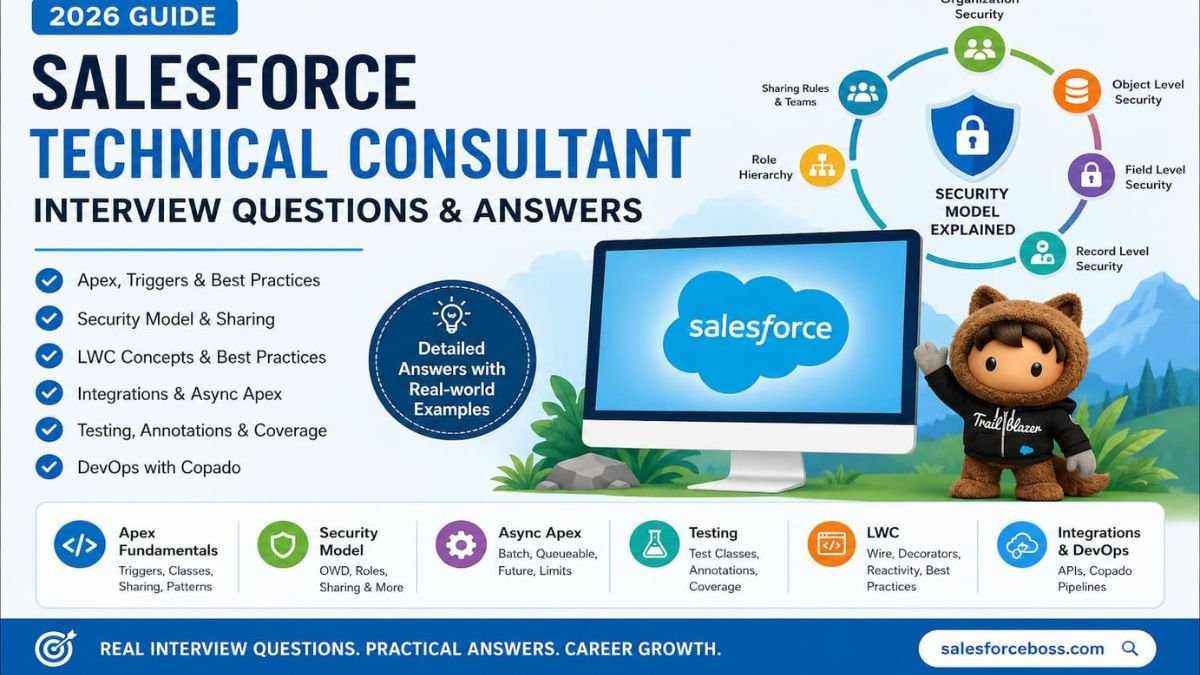
Salesforce Technical Consultant Interview Questions & Answers (2026 Guide): Preparing for a Salesforce Technical Consultant interview? Whether you are targeting roles in consulting companies, product-based organizations, or Salesforce partner firms, these are some of the most commonly asked interview questions for experienced Salesforce professionals.
In this blog, we will cover Salesforce Technical Consultant Round 1 interview questions along with clear and practical answers that can help you crack your next interview confidently.
Salesforce Technical Consultant Interview Questions & Answers
1. What do you understand by Salesforce? How is Salesforce different from other database applications?
Salesforce is a cloud-based CRM (Customer Relationship Management) platform that helps businesses manage sales, service, marketing, automation, and customer relationships in a centralized system.
Key Features of Salesforce
- Cloud-based platform
- Low-code and no-code capabilities
- Highly customizable
- Supports automation and integrations
- Multi-tenant architecture
What are Custom Objects?
Custom Objects are user-created database tables in Salesforce used to store business-specific data.
Example:
- Employee__c
- Vehicle__c
- Trade_In__c
What are Custom Fields?
Custom Fields are additional fields added to standard or custom objects.
Examples:
- PAN Number
- Vehicle Registration Number
- Discount Percentage
Relationships in Salesforce
- Lookup Relationship
- Master-Detail Relationship
- Many-to-Many Relationship
- Hierarchical Relationship
Difference Between Salesforce and Traditional Database Applications
| Salesforce | Traditional Database |
|---|---|
| Cloud-based | Mostly on-premise |
| Built-in security | Manual security implementation |
| Automation tools available | Requires custom development |
| Scalable and configurable | Heavy development effort |
| CRM-focused | Generic database system |
2. Explain the Entire Salesforce Security Model
Salesforce security works in multiple layers.
1. Organization Level Security
- Login hours
- IP restrictions
- Password policies
2. Object Level Security
Controlled using:
- Profiles
- Permission Sets
Permissions include:
- Create
- Read
- Edit
- Delete
3. Field Level Security
Controls field visibility and edit access.
4. Record Level Security
Handled through:
- Organization Wide Defaults (OWD)
- Role Hierarchy
- Sharing Rules
- Manual Sharing
- Apex Sharing
- Teams
3. What is Apex Sharing? Explain with Scenario
Apex Sharing is used to programmatically share records with users when standard sharing rules are insufficient.
Example Scenario
Suppose:
- Sales Managers should access only records belonging to their region.
- Complex custom logic determines access dynamically.
In such cases, Apex Managed Sharing is used.
Example:
AccountShare shareRec = new AccountShare();
shareRec.AccountId = acc.Id;
shareRec.UserOrGroupId = userId;
shareRec.AccountAccessLevel = 'Edit';
insert shareRec;
4. With Sharing vs Without Sharing vs Inherited Sharing
With Sharing
Enforces record-level sharing rules.
public with sharing class AccountService {
}
Without Sharing
Ignores sharing rules and runs in system mode.
public without sharing class AccountService {
}
Inherited Sharing
Inherits sharing behavior from the calling context.
public inherited sharing class AccountService {
}
Difference Between Without Sharing and Inherited Sharing
| Without Sharing | Inherited Sharing |
|---|---|
| Always ignores sharing | Depends on caller |
| Runs in system context | Flexible security handling |
| Less secure | Recommended for reusable frameworks |
5. What is Maximum Trigger Depth in Salesforce?
The maximum trigger depth is:
16If triggers keep recursively calling themselves beyond 16 levels, Salesforce throws:
Maximum Trigger Depth Exceeded6. How Can You Avoid Recursive Triggers?
Using only a static Boolean is not considered the best approach.
Better Approaches
- Static Set of Record IDs
- Static Map
- Change detection logic
- Trigger frameworks
- Old vs New comparison
Example
if(oldMap.get(acc.Id).Status__c != acc.Status__c){
   // execute logic
}
7. Do You Have Experience with Design Patterns?
Commonly used Salesforce design patterns include:
Singleton Pattern
Ensures only one instance of a class exists.
Factory Pattern
Creates objects dynamically based on conditions.
Trigger Handler Pattern
Separates trigger logic into handler classes.
Service Layer Pattern
Used for reusable business logic.
8. What Kind of Integration Scenarios Have You Worked On?
Common integration scenarios:
- Salesforce to ERP integration
- REST API integrations
- SOAP API integrations
- Middleware integrations
- Real-time and batch integrations
Example:
- Syncing Quotes from Salesforce to Equip system using REST APIs.
9. What is Point-to-Point Integration?
Point-to-point integration means two systems communicate directly without middleware.
Example
Salesforce directly calling SAP APIs.
Drawback
As systems increase, maintenance becomes difficult.
10. Different Annotations Used in Apex Test Classes
Common annotations:
@isTest@testSetup@TestVisible@future@InvocableMethod
11. Use of @testSetup Method
@testSetup creates reusable test data once for all test methods.
Benefits
- Faster test execution
- Reduced duplicate test data creation
Example:
@testSetup
static void setupData(){
    insert new Account(Name='Test');
}
12. When Would You Use SeeAllData=true?
Generally avoided.
Valid Scenario
When testing:
- Standard Price Book
- Historical organization data
- Certain setup objects
13. Can You Access Custom Metadata Without SeeAllData=true?
Custom Metadata
✅ Accessible in test classes without SeeAllData=true
Custom Settings
❌ Need explicit test data creation.
14. What is Test.startTest() and Test.stopTest()?
Purpose
- Resets governor limits
- Executes asynchronous jobs synchronously during testing
Example:
Test.startTest();
Database.executeBatch(batchObj);
Test.stopTest();
15. Why Does Batch Test Cover Only Start Method?
Possible reasons:
- Missing
Test.stopTest() - Batch scope not processed
- Incorrect query returning no records
16. Can You Call a Queueable from Another Queueable?
✅ Yes.
This is called Queueable Chaining.
17. Can You Call a Queueable from a Batch?
✅ Yes.
Usually done from:
finish()methodexecute()method
18. Queueable Limits
From Synchronous Context
You can enqueue:
50 queueable jobsFrom Asynchronous Context
Only:
1 queueable job19. What is Queueable Chaining?
Calling another queueable job from inside a queueable class.
Example:
System.enqueueJob(new SecondQueueable());Used for:
- Sequential processing
- Large data handling
20. Apex Best Practices
Recommended Best Practices
- Bulkify code
- Avoid SOQL inside loops
- Use collections
- Use trigger frameworks
- Handle exceptions properly
- Write proper test classes
- Use meaningful naming conventions
21. Decorators in LWC
Common decorators:
@api@track@wire
Example
@api recordId;22. JSON Changes Not Reflecting in LWC UI
Reason:
LWC reactivity issue.
If nested JSON objects are modified directly, UI may not refresh.
Solution
Create a new object reference.
Example:
this.data = {...this.data};23. Wire vs Imperative in LWC
| Wire | Imperative |
|---|---|
| Reactive | Manual call |
| Automatic execution | Explicit execution |
| Better for read operations | Better for complex logic |
Is Wire Reactive by Default?
Only if reactive parameters are used.
Example:
@wire(getData, {accId:'$recordId'})24. LWC Best Practices
- Keep components reusable
- Minimize Apex calls
- Use Lightning Data Service
- Avoid unnecessary re-rendering
- Handle errors properly
- Use pagination for large datasets
25. What is LWC OSS?
LWC OSS stands for:
Lightning Web Components Open SourceIt allows developers to run LWC outside Salesforce.
Used for:
- Standalone applications
- Faster UI development
26. Did You Follow LWC Best Practices Initially?
A good honest answer: Initially, I focused more on functionality and learning the framework. Over time, I started following best practices like component reusability, optimized Apex calls, proper state management, and clean architecture.
Interviewers usually appreciate honesty and growth mindset.
27. Experience with Copado
Copado is a Salesforce DevOps tool used for:
- CI/CD
- Deployment automation
- Version control
- Release management
Common Copado Activities
- Pipeline setup
- User story promotion
- Automated deployments
- Git branch management
Final Tips for Salesforce Technical Consultant Interviews
Focus Areas
- Apex fundamentals
- Security model
- Integrations
- LWC concepts
- Governor limits
- Asynchronous Apex
- Design patterns
- Real-time project scenarios
Interview Tip
Always explain answers with:
- Real project examples
- Best practices
- Business impact
That creates a stronger impression compared to theoretical answers only.
Conclusion
These Salesforce Technical Consultant interview questions cover important concepts frequently asked in interviews for mid-level and senior Salesforce roles. Preparing these questions thoroughly with practical examples will significantly improve your chances of cracking Salesforce Technical Consultant interviews in 2026.
Keep practicing real-world scenarios, integrations, triggers, LWCs, and governor limits to strengthen your technical confidence.
Check Other Companies Salesforce Interview Experience:
- Cognizant Salesforce Interview Experience: Click Here
- Infosys Interview Experience: Click Here
- TCS Interview Experience: Click Here
- Deloitte Interview Experience: Click Here
- Accenture Interview Experience: Click Here
Follow Us for Daily Salesforce Jobs Hiring Update:
| Social Platform | Links |
|---|---|
| Telegram | Join Here |
| Join Here | |
| Follow Here |
